
Do enjoy this award-winning CGI animated short.
“…a house which escapes from its suburban foundations and sets off on an epic journey.”
Published on Dec 27, 2014 by Home Sweet Home Team
Do enjoy this award-winning CGI animated short.
“…a house which escapes from its suburban foundations and sets off on an epic journey.”
Published on Dec 27, 2014 by Home Sweet Home Team
In 1921, in a Munich beer hall, newly appointed Nazi party leader Adolf Hitler gave a Christmas speech to an excited crowd.
According to undercover police observers, 4,000 supporters cheered when Hitler condemned “the cowardly Jews for breaking the world-liberator on the cross” and swore “not to rest until the Jew lay shattered on the ground.” Later, the crowd sang holiday carols and nationalist hymns around a Christmas tree. Working-class attendees received charitable gifts.
Given state control of public life, it’s not surprising that Nazi officials were successful in promoting and propagating their version of Christmas through repeated radio broadcasts and news articles.
But under any totalitarian regime, there can be a wide disparity between public and private life, between the rituals of the city square and those of the home. In my research, I was interested in how Nazi symbols and rituals penetrated private, family festivities – away from the gaze of party leaders.
While some Germans did resist the heavy-handed, politicized appropriation of Germany’s favorite holiday, many actually embraced a Nazified holiday that evoked the family’s place in the “racial state,” free of Jews and other outsiders.
One of the most striking features of private celebration in the Nazi period was the redefinition of Christmas as a neo-pagan, Nordic celebration. Rather than focus on the holiday’s religious origins, the Nazi version celebrated the supposed heritage of the Aryan race, the label Nazis gave to “racially acceptable” members of the German racial state.
According to Nazi intellectuals, cherished holiday traditions drew on winter solstice rituals practiced by “Germanic” tribes before the arrival of Christianity. Lighting candles on the Christmas tree, for example, recalled pagan desires for the “return of light” after the shortest day of the year.
Scholars have called attention to the manipulative function of these and other invented traditions. But that’s no reason to assume they were unpopular. Since the 1860s, German historians, theologians and popular writers had argued that German holiday observances were holdovers from pre-Christian pagan rituals and popular folk superstitions.
So because these ideas and traditions had a lengthy history, Nazi propagandists were able to easily cast Christmas as a celebration of pagan German nationalism. A vast state apparatus (centered in the Nazi Ministry for Propaganda and Enlightenment) ensured that a Nazified holiday dominated public space and celebration in the Third Reich.
Yet two aspects of the Nazi version of Christmas were relatively new.

A Christmas-themed stamp emphasizes light.
First, because Nazi ideologues saw organized religion as an enemy of the totalitarian state, propagandists sought to deemphasize – or eliminate altogether – the Christian aspects of the holiday. Official celebrations might mention a supreme being, but they more prominently featured solstice and “light” rituals that supposedly captured the holiday’s pagan origins.
Second, as Hitler’s 1921 speech suggests, Nazi celebration evoked racial purity and anti-Semitism. Before the Nazis took power in 1933, ugly and open attacks on German Jews typified holiday propaganda.
Blatant anti-Semitism more or less disappeared after 1933, as the regime sought to stabilize its control over a population tired of political strife, though Nazi celebrations still excluded those deemed “unfit” by the regime. Countless media images of invariably blond-haired, blue-eyed German families gathered around the Christmas tree helped normalize ideologies of racial purity.
Open anti-Semitism nonetheless cropped up at Christmastime. Many would boycott Jewish-owned department stores. And the front cover of a 1935 mail order Christmas catalog, which pictured a fair-haired mother wrapping Christmas presents, included a sticker assuring customers that “the department store has been taken over by an Aryan!”
It’s a small, almost banal example. But it speaks volumes. In Nazi Germany, even shopping for a gift could naturalize anti-Semitism and reinforce the “social death” of Jews in the Third Reich.
The message was clear: only “Aryans” could participate in the celebration.
According to National Socialist theorists, women – particularly mothers – were crucial for strengthening the bonds between private life and the “new spirit” of the German racial state.
Everyday acts of celebration – wrapping presents, decorating the home, cooking “German” holiday foods and organizing family celebrations – were linked to a cult of sentimental “Nordic” nationalism.

Christmas tree bulbs designed with the Swastika were one of a number of ways Christmas became Nazified
Propagandists proclaimed that as “priestess” and “protector of house and hearth,” the German mother could use Christmas to “bring the spirit of the German home back to life.” The holiday issues of women’s magazines, Nazified Christmas books and Nazi carols tinged conventional family customs with the ideology of the regime.
This sort of ideological manipulation took everyday forms. Mothers and children were encouraged to make homemade decorations shaped like “Odin’s Sun Wheel” and bake holiday cookies shaped like a loop (a fertility symbol). The ritual of lighting candles on the Christmas tree was said to create an atmosphere of “pagan demon magic” that would subsume the Star of Bethlehem and the birth of Jesus in feelings of “Germanness.”
Family singing epitomized the porous boundaries between private and official forms of celebration.

Sheet music for the popular carol “Exalted Night Of The Clear Stars”
Sheet music for the popular carol “Exalted Night of the Clear Stars
Propagandists tirelessly promoted numerous Nazified Christmas songs, which replaced Christian themes with the regime’s racial ideologies. Exalted Night of the Clear Stars, the most famous Nazi carol, was reprinted in Nazi songbooks, broadcast in radio programs, performed at countless public celebrations – and sung at home.
Indeed, Exalted Night became so familiar that it could still be sung in the 1950s as part of an ordinary family holiday (and, apparently, as part of some public performances today!).
While the song’s melody mimics a traditional carol, the lyrics deny the Christian origins of the holiday. Verses of stars, light and an eternal mother suggest a world redeemed through faith in National Socialism – not Jesus.
We’ll never know exactly how many German families sang Exalted Night or baked Christmas cookies shaped like a Germanic sun wheel. But we do have some records of the popular response to the Nazi holiday, mostly from official sources.
For example, the “activity reports” of the National Socialist Women’s League (NSF) show that the redefinition of Christmas created some disagreement among members. NSF files note that tensions flared when propagandists pressed too hard to sideline religious observance, leading to “much doubt and discontent.”
Religious traditions often clashed with ideological goals: was it acceptable for “convinced National Socialists” to celebrate Christmas with Christian carols and nativity plays? How could Nazi believers observe a Nazi holiday when stores mostly sold conventional holiday goods and rarely stocked Nazi Christmas books?
Meanwhile, German clergymen openly resisted Nazi attempts to take Christ out of Christmas. In Düsseldorf, clergymen used Christmas to encourage women to join their respective women’s clubs. Catholic clergy threatened to excommunicate women who joined the NSF. Elsewhere, women of faith boycotted NSF Christmas parties and charity drives.
Still, such dissent never really challenged the main tenets of the Nazi holiday.
Reports on public opinion compiled by the Nazi secret police often commented on the popularity of Nazi Christmas festivities. Well into the Second World War, when looming defeat increasingly discredited the Nazi holiday, the secret police reported that complaints about official policies dissolved in an overall “Christmas mood.”
Despite conflicts over Christianity, many Germans accepted the Nazification of Christmas. The return to colorful and enjoyable pagan “Germanic” traditions promised to revitalize family celebration. Not least, observing a Nazified holiday symbolized racial purity and national belonging. “Aryans” could celebrate German Christmas. Jews could not.
The Nazification of family celebration thus revealed the paradoxical and contested terrain of private life in the Third Reich. The apparently banal, everyday decision to sing a particular Christmas carol, or bake a holiday cookie, became either an act of political dissent or an expression of support for national socialism.

This article was originally published on The Conversation. Read the original article.
– altered by Hystoria
The great cataract of Niagara was all that he had hoped it would be. Blinded by its mist and deafened by its mighty roar, Dickens stood spellbound by the spectacle, amazed, he said, “How near to my Creator I was standing.” The buoyant `Boz’ [Dicken’s nickname] looked on in awe, elated by the “peaceful eternity” of nature in one of its more gigantic forms. It was particularly impressive from the Canadian side of the river where Dickens was delighted to be.

Dickens, an early adopter of the shower when it first became a household item in the 1840’s, was referred to his family ‘The Demon’. Dickens took cold showers, which he believed increased his manly powers
In 1842 Charles Dickens, the celebrated novelist and seasoned traveller, visited North America. He had been “haunted by visions of America” and intrigued by the prospect of touring the great Republic. His interest in a trip across the Atlantic was considerably stimulated by a letter he had received from the American writer, Washington Irving, who declared that Dickens would be “a triumph from one end to the States to the other.”
Dickens was anxious to begin the trip in spite of the prospect of a stormy crossing, so he and wife Catherine departed Liverpool on the steamship Britannia on the 2nd of January, 1842. After a rough voyage in which, he said, the little vessel was often “stopped, staggered and shivered by the angry sea,” they arrived in Halifax on the 19th. “I wish you could have seen the crowds cheering the inimitable in the streets.” This was Dickens’ first use of the word ‘inimitable’ to describe himself, “as if his reception in Canada and America now somehow justified it.”
Following a short but stirring Canadian welcome, Charles and Catherine proceeded down the coast to Boston from where they commenced their triumphal tour through the United States of America.
Dickens was rapturously received wherever he went and his first impressions of the country were quite favourable. He found the people “friendly, frank, kind and warm-hearted.” They were also self-righteous and surprisingly insecure with a “constant appetite for praise.” However, as time passed Dickens became somewhat disillusioned because of the people’s preoccupation with money and business, their seeming lack of humour and a “tyranny of public opinion” fostered by a “rancid press.”
While he was in the United States, Dickens used every opportunity to urge the abolition of slavery and to advocate an international copyright to prevent the pirating of British writers’ works by American magazines. His audiences had not come to hear about these matters, and over time they gradually began to resent him for raising them. Four months later in early May, Charles and Catherine sailed from Cleveland across the lake to Buffalo, then travelled by train to Niagara Falls, New York where they crossed into Canada and the “English side” of the river. Dickens felt free at last from the inquisitive press and the prying eyes of curious spectators who mauled and mobbed their honoured foreign guest without respite. He found Canadians less prying and pushy for which Dickens was thankful. Now they could rest. Despite this Dickens refused to comment on the differences between the two countries stating, “I wish to abstain from instituting any comparison, or drawing any parallel whatever, between the social features of the United States and those of the British Possessions in Canada. For this reason, I shall confine myself to a very brief account of our journeyings in the latter territory.”

The first photograph taken of Niagara Falls, Canada 1840
When they arrived at the railroad station in Niagara Falls, Ontario, Dickens saw “two great white clouds rising up from the depths of the earth.” He was frantic to see the wonder of the Falls up close and off they wildly raced. Dickens literally “dragged Kate down the deep and slippery path” that led to the ferry boat which took them to the very foot of the Falls. “There was a bright rainbow at my feet and from that I looked up to – great Heaven! to what a “fall of the bright green water.” Before him “was Beauty unmixed with any sense of Terror.” The stimulation of the sight and sound caused him to perspire freely.
The Dickens booked rooms at an inn that overlooked the Falls and spent the next ten days in complete relaxation. Charles was entranced by the Falls, and came each day to stare and marvel at its magnificence. The sound and sight of the “vague immensity” as it eased over the edge then plunged down the sheer rock face, conjured up an “image of the eternal.” It recalled for him another image, that of his dear departed sister-in-law, Mary Hogarth, whom he had loved and whose memory he cherished all of his life. He believed her spirit looked down on him from this eternal place as a result of which the site became sacred and sanctified in his mind.
As well as Niagara Falls the Dickens visited Toronto and Kingston. He visited the jail when he passed through the latter city in 1842 and recorded that he saw this “beautiful girl of twenty who had been in jail for several years.” She had, he wrote, “quite a lovely face though there was a lurking devil in her bright eyes which looked out pretty sharply from between her prison bars.” The young woman had acted as a courier for William Lyon Mackenzie and his compatriots when they occupied Navy Island. When on one occasion she attempted to steal a horse, she was caught, convicted as a rebel and jailed.
While Dickens was in Montreal he produced, directed and acted in three plays, two comedies and a farce of which he modestly declared, “I really do believe I was very funny.” Shortly after this acting interlude Charles and Catherine visited Quebec City which he found entrancing.
“The steamboats to Quebec perform the journey in the night; that is to say they leave Montreal at six in the evening and arrive at Quebec at six next morning. We made this excursion during our stay in Montreal (which exceeded a fortnight) and were charmed by its interest and beauty. The impression made upon the visitor by this Gibraltar of America: its giddy heights; its citadel suspended as it were in the air; its picturesque steep streets and frowning gateways; and the splendid views which burst upon the eye at every turn: is at once unique and lasting. It is a place not to be forgotten or mixed up in the mind with other places or altered for a moment in the crowd of scenes a traveller can recall. Apart from the realities of this most picturesque city, there are associations clustering about it which would make a desert rich in interest. The dangerous precipice along whose rocky front Wolfe and his brave companions climbed to glory; the Plains of Abraham where he received his mortal wound; the fortress so chivalrously defended by Montcalm; and his soldier’s grave, dug for him while yet alive by the bursting of a shell; are not the least among them among the gallant incidents of history. That is a noble Monument too and worthy of two great nations which perpetuates the memory of both brave generals and on which their names are jointly written.”
“The city is rich in public institutions and in Catholic churches and charities, but it is mainly in the prospect from the site of the Old Government House and from the Citadel that its surpassing beauty lies. The exquisite expanse of country, rich in field and forest, mountain-height and water, which lies stretched out before the view, with miles of Canadian villages glancing in long white streaks, like veins along the landscape; the motley crowd of gables, roofs, and chimney tops in the old hilly town immediately at hand; the beautiful St. Lawrence sparkling and flashing in the sunlight; and the tiny ships below the rock from which you gaze, whose distant rigging looks like spiders’ webs against the light, while casks and barrels on their decks dwindle into toys, and busy mariners become so many puppets; all this framed by a sunken window in the fortress and looked at from the shadowed room within, forms one of the brightest and most enchanting pictures that the eye can rest upon.”
Dickens found Canada delightful after the disappointment of the United States. On occasion it was a little too Tory for his liking and the inns left much to be desired – one in Montreal being the worst he had ever encountered – but on the whole he found it a pleasant surprise.
In His Own Words
“Canada has held and always will retain a foremost place in my remembrance. Few Englishmen are prepared to find it what it is. Advancing quietly; old differences settling down and being fast forgotten; public feeling and private enterprise alike in a sound and wholesome state; nothing of flush or fever in its system but health and vigour throbbing in its steady pulse: it is full of hope and promise. To me – who had been accustomed to think of it as something left behind in the strides of advancing society, as something neglected and forgotten, slumbering and wasting in its sleep – the demand for labour and the rates of wages; the busy quays of Montreal; the vessels taking in their cargoes and discharging them; the amount of shipping in the different ports; the commerce, roads, and public works, all made TO LAST; the respectability and character of the public journals; and the amount of rational comfort and happiness which honest industry may earn: were very great surprises. The steamboats on the lakes, in their conveniences, cleanliness, and safety; in the gentlemanly character and bearing of their captains; and in the politeness and perfect comfort of their social regulations; are unsurpassed even by the famous Scotch vessels, deservedly so much esteemed at home. The inns are usually bad; because the custom of boarding at hotels is not so general here as in the States, and the British officers, who form a large portion of the society of every town, live chiefly at the regimental messes: but in every other respect, the traveller in Canada will find as good provision for his comfort as in any place I know.”
From Quebec City they travelled to New York where they embarked for home on the George Washington on the 7th of June, arriving back in Liverpool on the 29th of June.
Dickens died at 58 on June 9th, 1870 from a cerebral hemorrhage and was buried in Poet’s Corner in Westminster Abbey. People world-wide mourned the death of a friend and a creative genius whose wonderful novels populated by unforgettable characters continue to bless us everyone.

– altered by Hystoria

(GER) Hansel und Gretel
Hansel and Gretel are sent into the forest by their mother to gather berries. The children get lost and stumble upon a house made of gingerbread, which proves too much of a temptation, despite the strange woman – a witch – who lives there.
This gives us a hint as to how the gingerbread house became a Christmas tradition – facades and rooftops baked by moms and dads and assembled by children each year.
This fairytale opera about a brother and sister who get lost in a forest was originally created by composer Engelbert Humperdinck and his sister Adelheid Wette as children’s entertainment; it soon turned into a full-fledged opera. Humperdinck’s colourful score and Wette’s libretto bring out the dark aspects of the Brothers Grimms’ fairytale and convey its humour and sense of hope. Hansel and Gretel was first performed in Weimar on the night before Christmas Eve in 1893. The opera opened in London on Boxing Day the following year, and has remained an enduring seasonal classic throughout Europe. – Royal Opera House
Hänsel und Gretel (Zurich Opera House 1999)
– altered by Hystoria
If you thought Christmas was all about good tidings and joy, you were wrong. The Coventry Carol is a song about infanticide and also a lullaby sung by mothers of doomed children.
Eggnog?
The English carol dates back to the 16th Century and was traditionally performed as part of a ‘mystery’ play – the nativity – by the city’s guild and was also a tool used to teach the illiterate the historical events which had taken place. The play gives a Biblical account of the “Massacre of the Innocents” and has since been a part of Western society’s elementary school Christmas pageants for many years.
Coventry Carol – performed by Westminster Cathedral Choir.
When Jesus was born, 3 Magi (wise men) followed the new King’s star to the East to bring him offerings and blessings. King Herod aka Herod the Great – Roman King of the Jews, directed the Magi to return to him with the name of the future ruler. The Magi did not know Herod had plans for the Holy wee one. We should thank our lucky stars – an angel intervened! It spoke to the Magi telling the 3 not to alert Herod of Jesus and his whereabouts.
Herod was not willing to give up his position and ordered all Jewish males under the age of 2 throughout Bethlehem and surrounding areas to be executed. Many infants, mothers and fathers suffered the consequences of the Magi’s tight lips; all in the name of protecting the new King and saviour. The number of slaughtered infants has never been stated and most likely was never recorded. If this sounds all too familiar; it is with good reason.
– altered by Hystoria

EH 4463P January 1954 Crashed Cessna 180 that carried Ernest and Mary Hemingway. Uganda, near Murchison Falls. Photograph in the Ernest Hemingway Photograph Collection, John Fitzgerald Kennedy Library, Boston
Perhaps Hemingway’s most eventful year was 1954. In Africa, Hemingway was almost fatally injured in two successive plane crashes. He chartered a sightseeing flight over the Belgian Congo as a Christmas present to his fourth wife, Mary Welsh. On their way to photograph Murchison Falls from the air, the plane struck an abandoned utility pole and crash landed in heavy brush. Hemingway’s injuries included a head wound, while Mary broke two ribs. The next day, attempting to reach medical care in Entebbe, they boarded a second plane that exploded at take-off. Hemingway suffered burns and another concussion, this one serious enough to cause leaking of cerebral fluid. They eventually arrived in Entebbe to find reporters covering the story of Hemingway’s death. He briefed the reporters and spent the next few weeks recuperating and reading his erroneous obituaries. – Edgar
– altered by Hystoria
Celluloid is a transparent, flammable plastic which deteriorates when exposed to moisture. Celluloid dolls are made from cellulose nitrate, alcohol, fillers and camphor pigments.

1890-1937 (GER) made bisque & celluloid doll heads – Shultz Marke
Celluloid replaced ivory allowing items such as: jewelry, mantel clocks, charms, hat pins, buttons, buckles, stringed instrument parts, fountain pens, cutlery handles and toys for children to be inexpensively mass-produced.

c.? (RUS) made celluloid doll head girl’s tea party set tea-cozy (eBay item)
A toilet training aide for both toddlers and grown men – surely.


Anatomically correct, yet politically incorrect – somehow – somewhere.

c.1930s (GER) made celluloid doll
– altered by Hystoria

Where do I plug in my iPod? (image courtesy of Retronaut.co)
The first electric hair dryer was invented in 1888 by French hairstylist Alexandre Godefoy, who then filed the first patent in 1890. Godefoy’s version produced only heat, did not blow air as depicted in the image above and was an extremely large floor-model not suitable for household use.

Are the breakfast toaster pastries ready yet, mother?
Some say the first hair blower was a vacuum cleaner combined with another home appliance – the toaster. The idea was to allow the toaster’s element to heat the air within the wooden heating box. The hot air was then sent through the out-take, forcing it through the hose then finally out the nozzle to the locks of wet hair.

A young girl sitting on a toy horse under a hairdryer at the salon in the 1950’s. (Photo by FPG/Getty Images)
With the creation of new hairstyles, the Coiffure needed a way to style and set without blowing away the desired outcome. The hood bonnet (shown above) allowed for air to be slowly buffered through small holes on its inner walls. Hot air gently circulated around the head, drying the hair while maintaining the coif. Home versions soon became available on stands or as table-top models.

Tuck, knit and dry
The soft-hood bonnets (shown above) were later used in homes by attaching the later model hand-held dryers and are still manufactured today.

Jadite Green Lander’s Hand-held Hair Dryer c.1940’s
The hand-held version wasn’t invented until 1908 by American, Gabriel Kazanjian. By 1915, it was available to those who could afford such luxury; the middle-class consumer. 1920 was the year more affordable models became available for most everyone. Still, the hand-held models were too cumbersome, as they were made mostly of metal parts. Once plastics were introduced, they became lighter and much easier to maneuver.
Carpal Tunnel Syndrome wasn’t the only risk. Using the dryers resulted in hundreds of annual electrocutions until significant legislation was set up in the 1970s and again in the 1990s. Dryers were also known to overheat causing fires. Now, due to safety regulations, they are considered a safe appliance to use with very few related deaths occurring.


 – altered by Hystoria
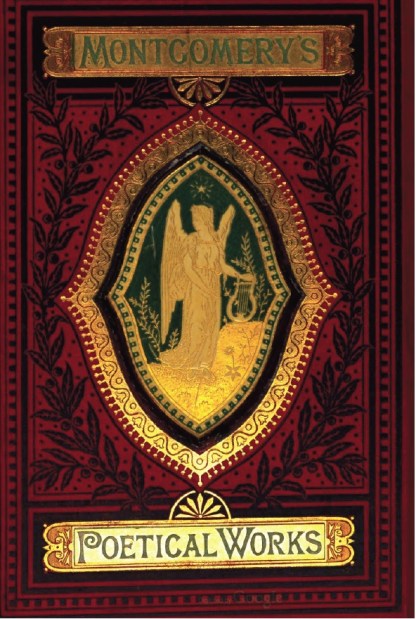
James Montgomery (November 4, 1717 – April 30, 1854)
Alive once more, respired her native air,
But found no freedom for the voice of prayer :
Again the cowl’d oppressor clank’d his chains,
Flourish’d his scourge, and threatened bonds and pains,
(His arm enfeebled could no longer kill,
But in his heart he was a murderer still 🙂
Then Christian David, strengtheri’d from above,
Wise as the serpent, harmless as the dove ;
Bold as a lion on his Master’s part,
In zeal a seraph, and a child in heart ;
PluckM from the gripe of antiquated laws,
( Even as a mother from the felon-jaws
Of a lean wolf, that bears her babe away,
With courage beyond nature, rends the prey,)
The little remnant of that ancient race :
Far in Lusatian woods they found a place ;
There, where the sparrow builds her busy nest,
And the clime-changing swallow loves to rest,
Thine altar, God of Hosts ! there still appear
The tribes to worship, unassail’d by fear ;
We cannot and absolutely will not apologize for the smiley emoticon at the end of line 6. If we were to remove the parentheses, ” () “we would be left with just the colon ” : ” therefore, we are keeping to its true format in which we found it.
If you are interested in reading the book in its entirety, you can do so by using Google: James Montgomery – Montgomery’s Poetical Works. You will be able to save the book in .PDF for your reading enjoyment.
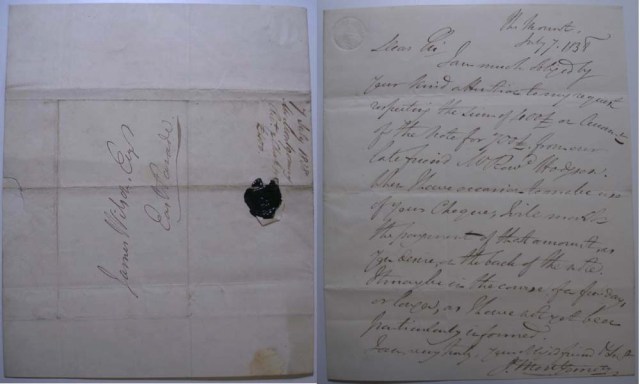
Letter from Montgomery to his Solicitor, James Wilson Esq., c. 1838
A handwritten letter on notepaper from James Montgomery to his Solicitor James Wilson Esq. of East Parade Sheffield, regarding a payment of £400 in part of a larger sum left to Montgomery by his deceased friend Rowland Hodgeson of Highfield, Sheffield.
The letter’s header reads The Mount (his Sheffield home) July 7, 1838. The reverse side of the paper is the address of the Solicitor and Montgomery’s black, wax seal.
– altered by Hystoria

 Hystoria