Folie à deux is French for “a madness shared by two”, or shared psychosis and is a psychiatric syndrome. Symptoms include delusional beliefs and are often accompanied by hallucinations which are passed from one individual to another. This particular disorder was first conceptualized in 19th-century French psychiatry by Charles Lasègue and Jean-Pierre Falret and is also known as Lasègue-Falret Syndrome.
The disorder does not discriminate; meaning anyone can pass their delusions onto another whether the other is a twin, siblings from separate births, any relative, or friends. Two people can be perfectly stable when not together, but when together can brew up a terrifying storm of horrific delusions, putting themselves and others at risk. The documentary “Madness in the Fast Lane – Ursula and Sabina Eriksson”, which we are presenting to you today, will demonstrate just how horrifying this disorder can be for all involved.
If you should happen to explore this story further on your own, you will most definitely run across conspiracy theories pertaining to this specific event. Don’t fret, as it is only more hysteria. You can easily study the disorder on its own to validate the authenticity of the syndrome’s symptoms.
January 17, 1775 – Kalisk, Poland – 6 women said to be witches were burnt at the stake. Some sources claim 9 women while others say 14, yet others state the women may never have been executed at all. Not even the year in which the trial took place can be agreed upon as some claim the tragedy took place in 1783. Other conflicting ‘facts’ in this story have sources claiming the ‘witches’ were tried for causing bad harvests while others state the women were believed to have caused illness of a local nobleman’s wife by use of witchcraft.
We hear a lot of talk about climate change, but not much on the Earth’s natural cycle – a cycle that takes place approximately every 26,000 years known as Milankovitch Cycles. It is natural. We have all taken note of the weather patterns we are now experiencing. It is also natural to be fearful. We cannot control nature, as Mother Earth is a living organism and she is always moving and changing beneath our feet. Humans will learn to adapt as we always have.
If you plan on travelling the Province of Ontario, be sure to travel through the Ottawa Valley area and visit the Bonnechere Museum – the fossils say it all. Learn how the Northern Hemisphere was tropical at one time – and perhaps will be again and again. Don’t forget to take a tour of the caves. You’ll be glad you did!
Read:
When Natalia Rybczynski unearthed the first few bone fragments on a windswept ridge in Canada’s High Arctic, she knew she was onto something big.
Rybczynski, a paleobiologist at the Canadian Museum of Nature, recalls thinking: “This is something kind of off the charts.”
It turns out she had uncovered the remains of the first camel ever found in the High Arctic.
The remarkable discovery, announced Tuesday, shows the humped creatures lived in forests that extended as far north as Ellesmere Island 3.5 million years ago during a global warm spell that the scientists say holds important lessons for the modern world.
“The camel is an ambassador for climate change,” says John Gosse, an earth scientist at Dalhousie University and co-author of the report on the camel published Tuesday in the journal Nature Communications.
Close-up of a fragment of High Arctic camel fossil lying on the ground of the Fyles Leaf Bed site – 2008. Martin Lipman/Canadian Museum of Nature
The researchers say the find also provides evidence the camels now plodding over the sand dunes in Africa and the Middle East can trace their origins back to giant camels that evolved in Northern Canada.
“This is a completely new way of thinking about the traits that we see in camels today,” says Rybczynski.
The evidence suggests the animals were originally “northern forest specialists,” she says. And their iconic humps, which store fat, would have been very useful for surviving long, cold Arctic winters.
It also points to the remarkable “versatility and adaptability” of camels that now put their big feet and humps to use in the desert.
The Ellesmere camel is the latest addition to a menagerie of prehistoric creatures that have been uncovered on often barren landscapes in Canada’s Arctic.
The research team led by the Canadian Museum of Nature was exploring a rich fossil bed on Ellesmere, known as the Beaver Pond site, that contains the remains of a boreal forest and wetland as well as ancient black bears, beavers, horses, rabbits and “deerlets.”
At the suggestion of a geologist at the Geological Survey of Canada, Rybczynski says they headed down to check out a sediment ridge about 10 kilometres to the south.
They knew they were onto something when she uncovered bone fragments on that first visit in 2006. They returned in 2008 and 2010 collecting more than two dozen bits of bone.
It then took another three years of sleuthing by Canadian and British researchers to figure out the fragments came from a giant camel’s limb bone.
Rybczynski says one telling chunk was characteristic of a cloven-hoofed animal. But molecular tests provided the most compelling evidence.
Mike Buckley at the University of Manchester extracted and analyzed collagen from the bone fragments that had survived over the eons. He says the cold Arctic climate helped preserve the tightly linked collagen molecules, which vary from species to species.
Buckley’s “collagen fingerprinting” revealed the Ellesmere camel was “nearly identical” to another ancient camel unearthed years ago in the Yukon.
The testing also showed that both Canadian animals were from the same line of camels that hiked from North America into Asia over the Bering Land Bridge seven to eight million years ago.
Camels originated in North America about 45 million years ago and underwent most of their evolution on this continent before dying off. Over the years camel bones have been unearthed in Alaska and the Yukon, but the Ellesmere find is significant because it is 1,200 kilometres farther north making it the “first evidence of a High Arctic camel.”
Gosse’s group at Dalhousie University used a sophisticated dating technique to show the Ellesmere bone fragments are about 3.5 million years old.
When the scientists put all the pieces together, what emerges is a giant camel about 30 per cent larger than today’s camels, weighing about 900 kilograms and standing about 2.7 metres high at the shoulders.
The camels lived in a boreal forest on Ellesmere dominated by larch trees that provided plenty to eat.
There was 24-hour sunshine in the summer and months of darkness in the snowy winters when the camels grew saggy coats to stay warm and survived on fats stored in their humps.
“It was a really different world then,” says Rybczynski.
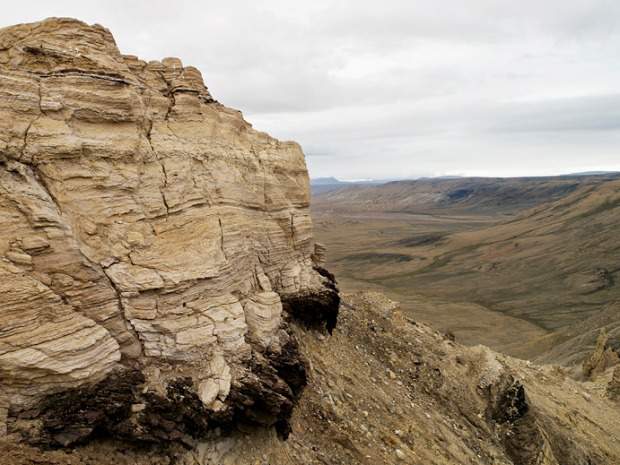
View of Strathcona Fiord from the top of the Fyles Lead Bed site, the area where the bones of the High Arctic camel were found. Martin Lipman/Canadian Museum of Nature
Martin Lipman/Canadian Museum of Nature
View of Strathcona Fiord from the top of the Fyles Leaf Bed site, the area where the bones of the High Arctic camel were found.
But she and her colleagues say the camel and its ancient Arctic world hold important lessons.
Slight changes in the Earth’s orbit are believed to have triggered a global temperature rise of two to three degrees about 3.5 million years ago. Due to poorly understood feedback mechanisms in the climate system, the warming was greatly amplified in the Arctic with temperatures on Ellesmere rising 14 to 22 C, allowing the forests — and camels — to move north.
As temperatures rose and Arctic glaciers and ice melted, Gosse says the Northwest Passage and channels around Canada’s Arctic islands were filled with sediments that prevented ocean water from circulating and cooling the landscape. And there was enough precipitation to grow forests in the region that had been a “polar desert.”
Gosse and Rybczynski say it is hard to know how the Arctic will respond in coming decades to the warming linked to human production of greenhouse gases. The average global temperature is expected to warm by at least 2 C with more pronounced warming in the Arctic, which is already evident in the record summer Arctic ice retreats in recent years.
They say the fossils and sediments in the Arctic from the warm period known as the mid-Pliocene, when the camels lived on Ellesmere, could hold clues of what to expect.
“The mid-Pliocene is a historical analog for future warming,” says Rybczynski. “It is a potentially very important time for understanding processes in the High Arctic and getting our heads around what might be happening next and how fast it might happen.”
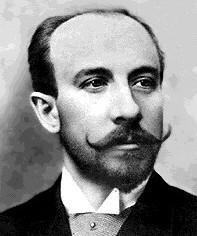
Marie-Georges-Jean Méliès, (Paris: December 8, 1861 – January 21, 1938) was an illusionist and filmmaker famous for creating special effects such as dissolves, multiple exposure, hand-painted colour and time-lapse photography. Marie, is also know for the stop-trick, where he claimed he accidentally achieved the effect when his camera jammed while filming traffic. However, film Historians put their noses to the grindstone and found that Marie’s trick was just that – a trick. Historians learned that the effects were crafted carefully by Marie’s masterful skills in splicing and frame matching, which allowed Marie to create stupefying effects such as disappearing women, men changing into women and vehicles morphing into other models.
The allure of magic took control of Marie’s life, building into a strong passion to obsession. This passion was no match for his father’s demands; manning the family’s boot factory where he was expected to carry on the family business with siblings. Marie’s father wasn’t supportive of his endaevours by no means – not the magic, nor Marie’s desire to paint. This did not stop Marie from following his heart. He sold his shares of the family business to his brothers and instead, could be found at the Egyptian Hall where he would watch London illusionist, John Nevil Maskelyne perform. He could later be found attending shows at Théâtre Robert-Houdin, founded by the infamous magician and illusionist, Jean Eugène Robert-Houdin. Marie then studied under Emile Voisin, who gave Marie his first crack at performing shows at Cabinet Fantastique of the Grévin Wax Museum, and later at the Galerie Vivienne.
Later, Marie, created Star Film Company with Reulos. They went on to produce many films in most, if not all genres; science, horror, fantasy and so on, using Marie’s skills in magic and film to dazzle audiences. Stag, or pornographic films were produced such as Peeping Tom at the Seaside, A Hypnotist at Work and the one you’re about to watch – After The Ball – the only one of the 3 films to have survived. The film stars Jeanne d’Alcy, where she is seen stripping down to a flesh-colored leotard, or tights – very fashionable for women of today and come in an assortment of colours. Jeanne, is being bathed by her maid, also making this the first girl-on-girl film.
After the Ball – World’s 1st Adult Film – Apres le Bath First Movie
The video you’re about to watch is the first movie to be copyrighted in the United States by The Edison Manufacturing Company – a company organized in 1889 by inventor and entrepreneur Thomas Edison.
Record Of A Sneeze, was filmed shortly after New Year’s Eve of 1894 between Jan. 2nd and 7th and released on the 9th. Shot by William K.L. Dickson with Thomas Edison’s assistant, Fred Ott as the star, the 5 seconds of silent film shows Mr. Ott taking a pinch of snuff to help induce the sneeze.
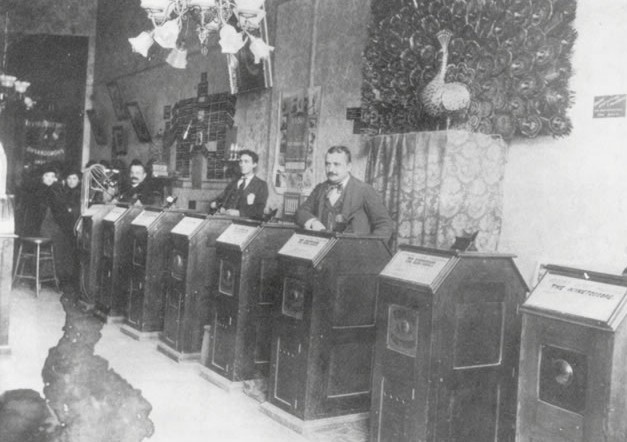
The Kinetiscope itself, was a device that allowed one person to view the film at one time; much like the once popular toy View-Master, which allowed just one child to view the slides while another may have sat waiting patiently for a turn. To view the motion picture, one had to peer through a peephole at the top of the Kinetiscope.
The company also produced batteries (for telegraph, phonoplex, and telephone systems), dental and medical instruments, machinery and appliances such as electrical fans. When film-making seemed to be a lucrative business, Edison Manufacturing created Edison Studios which went on to make approximately 1,200 films with only 54 being full-length.
San Francisco Kinetoscope Parlor ca. 1894-95
The first production facility was Black Maria studios located in West Orange, New Jersey which was built in the winter of 1892–93. A second facility built with an enclosed, glass rooftop was located at 41 East 21st Street in Manhattan’s entertainment district. It opened in 1901. In 1907, Edison’s newer facilities were built on Decatur Avenue and Oliver Place in the Bronx. The studios were closed in 1918.
The United States Library of Congress selected Record Of A Sneeze for preservation within the National Film Registry declaring it “culturally, historically, or aesthetically significant”.
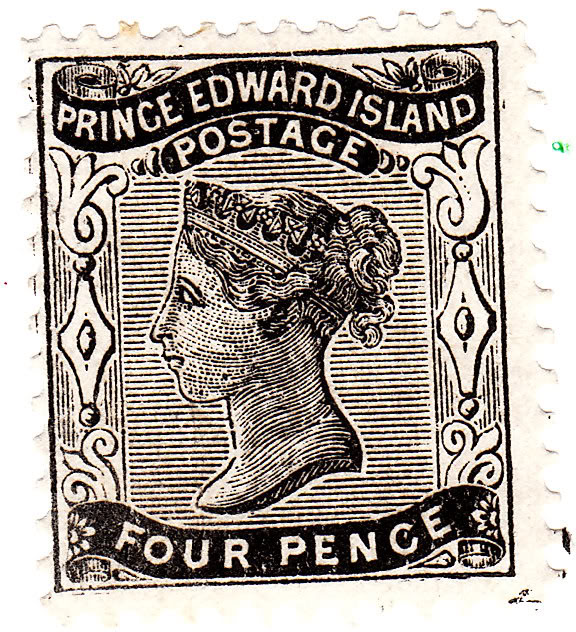
We apologize for not having a photograph of Miss Elizabeth Mukely, as photography was just in the experimental stages during her 1778 trial and sentencing. Not one courtroom etching of this day can be found – but she did in fact exist. We’ve chosen this four-pence stamp, as it is symbolic of her punishment.
In the late 1700s, P.E.I.’s criminal code had numerous offences that were punishable by death, such as murder, treason, rape, theft, arson and so forth.
The first sentence of death ever pronounced in the colony condemns servant Elizabeth Mukely for stealing £7.7s from her master, Gideon Ticeborn, equaling approximately $1617 today. It’s understandable why Mr. Gideon would be ticked. This wasn’t a $5 theft to afford milk and bread for the hungry kids at home. This would have made for a shopping spree fit for a Queen!
She was exiled; sent to Nova Scotia never to return when no one would consent to act as hangman due to her gender. Lucky No.7 wins it for this two-armed, delicate bandit. As for Mr. T. Gideon, there isn’t much available information as to whether he is to be associated with The Gideons’, who’s primary activity is distributing copies of the Bible – free of charge.
The Babylonians were the first to celebrate New Year’s festivities known as Akitu. This Spring Equinox festival began on the first days of the Babylonian year being in the months of March, or April – when soil was ready for sewing of barley. The named given to the “beginning of the year” was rêš šattim.
The festival was a conglomerate of celebrations lasting 12 days and were carried out at two locations: in the temple of the supreme god Marduk, the Esaglia, and the ‘house of the New year’ which was situated north of the city. The two gods at the center of the festival were Nabû and his father, the supreme god Marduk, who in the first millenium BCE, was usually called by the name ‘Bêl’, Lord, because his real name was considered too holy to be pronounced.
One activity practiced during the 12 days was the humiliation and slapping of The King. He would be struck across the face and if tears formed, he kept his place on the throne. Perhaps this was also the beginning of ‘crocodile tears’ – the fake tears people shed when the situation calls for a good, theatrical sobbing. It’s certainly safe to say present day Kings and world leaders are pleased that this portion of New Year’s is no longer practiced.
Palmyra’s Temple of Bel
The Akitu festival continued for centuries, and not only in Babylon. In Palmyra, the temple of Baal (another spelling) was inaugurated on the same date as Akitu. At the beginning of the third century CE, it was still celebated in Emessa in Syria, to honor the god Elagabal; the Roman emperor Heliogabalus (218-222) even introduced the festival in Ital. (Livius)
It is simple to see how Christmas and New Year’s celebrations were transformed from the ancient Babylonia to today’s traditions; food, drink, song and dance.
ID Artifact No. 3588, Fort Albany by W.A. Kenyon in The History of James Bay: 1610-1618: A Study in Historical Archaeology (1986) [Royal Ontario Museum]
The name for this darling prehistoric figurine is quite suiting – Star Man. He was uncovered by archaeologists excavating the site at Fort Albany, Ontario. Star Man, was cut from a sheet of lead and is 2.0cm thick. He measures 4.5cm high and 4.0cm wide.
Facts
Fort Albany First Nation is an Ojibway and Cree First Nation reserve in Cochrane District in Northeastern Ontario, Canada
Mound Builders were inhabitants of North America who, during a 5,000-year period, constructed various styles of earthen or earthwork mounds for religious and ceremonial, burial, and elite residential purposes
Earthwork started at an early date well before the pyramids of Egypt and are astronomically aligned; in many cases equal to anything found in Egypt
Ancient Wall of Atlanta off the Georgia coast on Sapelo Island, archaeologists unearthed the remains of an ancient walled city which predates the construction of Egypt’s pyramids; constructed around 2300 B.C.
“Human presence in the James Bay area is believed to have begun some 7000 years ago, although the earliest artefacts recently found in the region of Waskaganish date to some 3000-3500 years old. Aboriginal hunting groups migrated from the south and west, first as seasonal hunting parties and later permanently establishing themselves in what is known as Eeyou Istchee (the Cree traditional territory in eastern James Bay). Although populations fluctuated over the centuries, the pre-contact period is characterized by a subsistence economy based on hunting and trapping of small and large game, fishing and seasonal gathering.”— WFN, 2013
During Prohibition, the U.S. Treasury Department authorized physicians to write prescriptions for medicinal alcohol. Licensed doctors, with pads of government-issued prescription forms printed on treasury paper, advised their patients to take regular doses of hooch to stave off a number of ailments—cancer, indigestion and depression among them.
Alcohol is a depressant, which may have some of us wondering if this wasn’t pure quackery. It was.
E 108142 Medical Alcohol Permit – Prescription: Whiskey – (Empire Distillery) Easton PA. – issued to Mr. P. Barron on 3.16.1929
We are now experiencing the same ordeal with Medical Cannabis, which many hopefuls are waiting to see legalized. There is an ongoing argument whether or not the Government should have full control over the plant; distribution and taxation which would help grow the economy, or to legalize allowing the people to have more control; growing themselves. There are many Medical Cannabis distribution centres opening in some US and Canadian cities, where you can choose a strain with different levels of THC that best suits your needs. If you do not like the idea of inhaling smoke, which is completely understandable, there is another option for you – edibles! Delicious, medicated cookies and other baked goods are available. Marijuana was the name given to Cannabis during the reefer madness era, therefore we will call it by the plant’s proper name – Cannabis.
This privilege was one of the few legal exceptions to the 13-year ban on the production, sale and distribution of alcohol, initiated in 1920 by the 18th Amendment. The National Prohibition Act, which enforced the ban, also allowed farmers to produce wine for their own consumption and priests, ministers and rabbis to serve it during religious ceremonies.
B 90371 Medical Alcohol Permit – Sedalia, MO. – issued by Dr. Fowler on 3.4.1924 to Mr. R. J. Wood
Every ten days, patients willing to pay about $3 for a prescription and another $3 or $4 to have it filled could get a pint of booze. “There may have been some people who were being prescribed because there was a perceived medical need, but it was really a way for some physicians and pharmacists to make a few extra bucks,” he says.
A 37588 Medical Alcohol Permit (Brewer Missouri Pharmacy Bar – Man Cave) Sedalia, MO.- issued to Mr. Fisher on 10.4.1923
Both Canada and the USA experienced the great days of prohibition, making speakeasy clubs such as the Man Cave, popular spots to get your fix of hooch. Al Capone, is obviously one of the big names that will be forever attached to the History of Prohibition.
The Sleeman family tradition was passed down from generation to generation. Father to son, again and again.
UNTIL, ONE DAY, IT STOPPED.
On the heels of the roaring twenties, prohibition set in. In their true rebellious nature, the Sleeman family kept their beer flowing, brokering deals with bootleggers and gangsters like Al Capone.
No. 2483 Ted’s “Give Inn” Club speakeasy membership card
If you weren’t a member of a club, such as the Man Cave, you could have received an invitation by a friend who carried a membership card. Personal home parties were also the rage. Invitations were handed out in the form of business cards, which could be easily hidden away by tucking the card into a wallet or clutch.





 Hystoria