Our Fancy – The Peanut Butter Solution: List of Ingredients

List of Ingredients:

1 really ripe banana

5 dead flies

1 rotten egg

3 licorice leaves

A fistful of kitty litter

3 Connie Crisps

3 Crosbie Crackers

9 spoons of soil, a glass of pepper’s fizz and a spoonful of peanut butter – but not too much!

Some recipes should never be tweaked. When all ingredients are properly mixed, put it on your head – but only if you’ve contracted ‘The Fright’ –  a condition which affects those whom have entered an abandoned mansion –  seen a ghost, which leads to the shedding of each hair from the scalp of the poor victim as they lay asleep.

This  flick is full of magical paint brushes, fast-growing locks of hair, school suspensions, knockout drinks, the kidnapping of children where the use of the imagination is forbidden, and if not enough paint brushes are produced each day — no supper!

Definitely a rare, 1985 classic (allergy warning: may contain traces of nuts).


– altered by Hystoria

Posted in Children, Cooking Magic, Entertainment, Our Fancies | Tagged , , , , , , , , , , , , , , , , , , , , , , , , , , , | 1 Comment

Faust: The Opera – Opens March 19, 1859


Faust is a grand opera in five acts by Charles Gounod to a French libretto by Jules Barbier and Michel Carré from Carré’s play Faust et Marguerite, (loosely) based on Johann Wolfgang von Goethe’s Faust, Part 1. It debuted at the Théâtre Lyrique on the Boulevard du Temple in Paris on this day of  March 19,  1859.


ACT I
Faust, is a scholar who feels his life work – invaluable rubbish – has stolen away the best of his years, robbing him of a life of love. He attempts suicide twice with poison; a choir interrupts both attempts. Faust denounces Science and faith and asks  for infernal guidance. Upon doing so, Méphistophélès (a demon) appears with a seductive image of Marguerite, at her spinning wheel, which persuades Faust to purchase  Méphistophélès’s services on earth in exchange for Faust’s in Hell. Faust’s goblet of poison is  transformed by the Alchemist, Méphistophélès, into an elixir of youth, returning the aged Doctor’s youth and beauty; the strange companions are  then set out into the world.

– altered by Hystoria

Posted in Entertainment, Mythology | Tagged , , , , , , , , , , , | Leave a comment

Canadian Classic Cinema – The New Waterford Girl

A movie for a younger audience, perhaps – not a bad flick for those whom might be bored on a Sunday afternoon – “The New Waterford Girl” offers under-aged drinking, drug-taking and fighting during the 1970’s

Mooney, a young Canadian girl from the East Coast, is drastically seeking a way to leave her small, Nova Scotia town for her chance at a new life in New York after being awarded a scholarship which her mother disapproves of. A young girl, Lou Benzoa – a tough rock ’em sock ’em chick from New York, who’s special powers work wonders on the guilty – moves next door with her single mother, to (Mooney) – who then fakes a pregnancy to be shipped out of town by her embarrassed, Catholic family… and so on…


– altered by Hystoria

Posted in Entertainment | Tagged , , , , , , , , , , , , , , , , , , , , , , | Leave a comment

Our Fancy – Time Trap


A short film which brings back great memories of  working in the weld shops. Keep on truckin’, boys!

Written and Directed by: Michael Shanks

– altered by Hystoria

Posted in Our Fancies | Tagged , , , , , , , | Leave a comment

Hilarious House of Frightenstein -The Best Of Children’s TV


Hilarious House of Frightenstein – the very best children’s television show that ever was.


https://www.youtube.com/watch?v=geOAXYL_FDo


Posted in Children, Entertainment | Tagged , , , , , , , , , , , , , , , , , , , , , , , , , , , , , , , , , , , , , , , , | Leave a comment

Das Triadische Ballet – Bauhaus (1921 – 1929)


Das Triadische Ballet (The Triadic Ballet) is an Oskar Schlemmer’s creation – a symphonic dance, divided into three parts – a trinity, which evolve from the hilarity to the gloomy.

https://www.youtube.com/watch?v=87jErmplUpA

Oskar Schlemmer (September 4, 1888 – April 13, 1943) was a German painter, sculptor, designer and choreographer associated with the Bauhaus school.


Where did Oskar’s ideas come from? According to Wikipedia –

his observations and experiences during the First World War, Oskar Schlemmer began to conceive of the human body as a new artistic medium. He saw ballet and pantomime as free from the historical baggage of theatre and opera and thus able to present his ideas of choreographed geometry, man as dancer, transformed by costume, moving in space.

One could say Oskar  opened doors for today’s musicians such as the late, David Bowie and Marilyn Manson, when it comes masterfully blending  music and theatrics to skillfully entertain the masses. Oskar’s idea of the human body’s movements being ‘mechanical’ brings to mind Marilyn Manson’s album, “Mechanical Animals” and the strange costumes and movements used within the performance throughout Manson’s music video. David Bowie’s costume designs have always been far-out, space-age, day-dreamy fun – for the most part.

Schlemmer saw the modern world driven by two main currents, the mechanised (man as machine and the body as a mechanism) and the primordial impulses (the depths of creative urges). He claimed that the choreographed geometry of dance offered a synthesis, the Dionysian and emotional origins of dance, becomes strict and Apollonian in its final form. – Wiki

– altered by Hystoria


Posted in Entertainment, The Joy of Musik, Wartime | Tagged , , , , , , , , , , , , , | Leave a comment

POSTMORTEM – The Pattern of Hypostasis

AprilcemeteryscenePostmortem
Cessation of circulation and loss of muscle tone after death allows blood within vessels to ‘settle under gravity’, producing a pink/ purple colour in those areas of the body that are lowest, or ‘dependent’. In a body lying on its back, the back of the body show hypostatic discolouration, save for those areas compressed by direct contact with a firm surface, such as the buttocks and shoulder blade regions, for example.


The forensic significance of hypostasis is overstated in many textbooks, and was historically used as a means of providing a timetable for the postmortem interval. Modern forensic pathology aims to be evidence-based, and to provide cautious opinions regarding such phenomena, which are so heavily influenced by factors which may not be capable of adequate investigation, such as the temperature of the microenvironment in which the body lies.

1-2790008-5f99154e-71b2-4da5-98a7-317d25f27e3b

Intense posterior hypostasis

Hypostasis may never actually appear (for instance in infants, the elderly, or those who were clinically anemic in life), and Fechner et al (1984) found that there was no linear relationship between the time at which no further movement of blood under gravity could occur (and the hypostatis was described as being ‘fixed’) and the time since death. Suzutani et al (1978) found that blood was mobile, and could therefore move under gravity, for up to 3 days. Most forensic pathologists would agree that hypostasis was maximal/ fully developed after about 12 hours.


The pattern of hypostasis may provide useful investigative information; if the distribution of hypostasis is on the back of the body, but the body is discovered lying on its front, the body has been moved after a sufficient time has elapsed during which posterior hypostasis has developed and become ‘fixed’.


When a body has lain on its front, postmortem hypostasis will devlop on the front of the body. Blood settling in lax soft tissues of the face can cause petechiae, and sometimes larger coalescences of petechiae (vibices or ‘Tardieu spots’), perhaps with pallor due to compression around the mouth and nose. In such circumstances, the pattern of hypostasis may appear sinister, and suggest that compression of the mouth/ nose (suffocation) had occurred. Detailed pathological dissection of the face and neck in such cases will frequently be able to distinguish such scenarios, but pressure to the face/ neck may not always be capable of being excluded. – 
I. Keränen


– altered by Hystoria

Posted in Death & Culture, Medical Arts & Science | Tagged , , , , , , | Leave a comment

Mr Potter’s Museum of Curiosities


Mr. Potter’s museum had over 10,000 stuffed animals which included a tableaux of:

“…a rats’ den being raided by the local police rats … [a] village school … featuring 48 little rabbits busy writing on tiny slates, while the Kittens’ Tea Party displayed feline etiquette and a game of croquet. A guinea pigs’ cricket match was in progress, and 20 kittens attended a wedding, wearing little morning suits or brocade dresses, with a feline vicar in white surplice. The kittens even wear frilly knickers under their formal attire!”

The museum closed in the 1970s, relocated and briefly re-opened at the Jamaica Inn, Bodmin Moor, in 1984, where it attracted over 30,000 visitors per year. In 2003, the exhibits were put up for auction. Damien Hirst first offered to buy the complete collection for £1million – but auctioneers Bonhams sold each piece individually, raising only £500,000. Amongst the buyers were pop artist Peter Blake, photographer David Bailey, and comedian Harry Hill. At the time, Hirst wrote in the Guardian:

“Mr Potter’s Museum of Curiosities at Jamaica Inn on Bodmin Moor is a fantastic Victorian-Edwardian collection of stuffed animals and curios. There are hundreds of items, all collected or devised by the original Mr Potter, who was a self-taught taxidermist. You can see he knew very little about anatomy and musculature, because some of the taxidermy is terrible – there’s a kingfisher that looks nothing like a kingfisher. But there’s some great stuff in there, too – two-headed goats, a rhino’s head, a mummified human hand. As an ensemble, it’s just mad.

“My own favourites are these tableaux: there’s a kittens’ wedding party, with all these kittens dressed up in costumes, even wearing jewellery. The kittens don’t look much like kittens, but that’s not the point. There’s a rats’ drinking party, too – which puts a different construction on Wind in the Willows. And a group of hamsters playing cricket.

“I’ve offered £1m and to pay for the cost of the auctioneer’s catalogue – just for them to take it off the market and keep the collection intact – but apparently, the auction has to go ahead. It is a tragedy.”

Last year, a one-off exhibition was co-curated by Peter Blake, who brought Potter’s curios together at the Museum of Everything in Primrose Hill, London.

It should be noted that Potter’s museum claimed all “animals died of natural causes.”

The following film was produced by British Pathe in 1965, and describes Potter as “a genius who made fur-lined dolls into whimsical but veritable works of poetic art.”


– altered by Hystoria

Posted in Adults, Children, Death & Culture, Entertainment, Taboos | Tagged , , , , , , , , , , , , , , , | Leave a comment

Mouse Killed by 150-Year-Old Trap in English Museum Display

jjjjahah-674x464

Museum of Rural Life in Reading, England

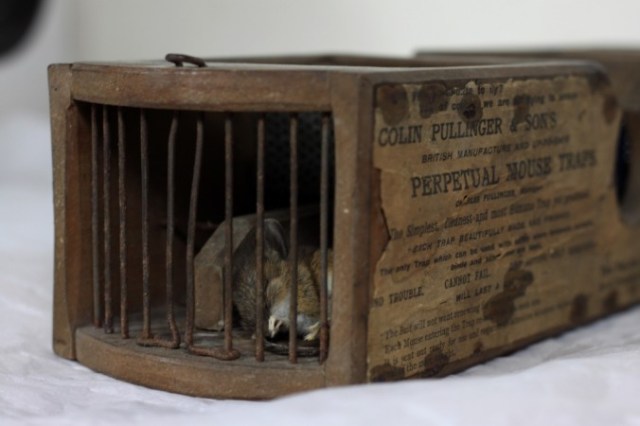
A mouse was apparently killed by a 150-year-old trap inside a museum display in the United Kingdom, officials said.

Staff at the Museum of Rural Life in Reading, England got an email saying that a dead mouse was found in a mousetrap.

“There appears to be a dead mouse in this mousetrap … which is not described as being there on the database,” read the email.

It appears that the mouse went to the trap, which was part of a gallery, for warmth, the museum stated.

m123j3j3132

Museum of Rural Life in Reading, England

“So, this retired rodent had managed to sneak past University of Reading security, exterior doors and Museum staff, and clambered its way up into our Store. Upon finding itself there it would have found the promised land; a mouse paradise laid before it full of straw, wood and textiles. Then, out of thousands of objects, it chose for its home the very thing designed to kill it some 150 years ago: a mouse trap,” stated the university.

osu2342143-676x450

Museum of Rural Life in Reading, England

The old trap was not baited. It was manufactured by Colin Pullinger & Sons of Silsey, West Sussex. It’s unclear exactly when the trap was made, but it was patented in 1861.

The trap, however, says that it will “last a lifetime,” which is appropriate.

trap11

Museum of Rural Life in Reading, England

“For the moment, however, the mouse remains in the trap while we decide what to do with it. One option is a dignified burial, another is to desiccate it or have it prepared to remain as a permanent feature of the mouse trap for our new displays. We’ll let you know what we decide,” the curators said.


–  altered by Hystoria


Posted in Inventions, Relics & Artifacts | Tagged , , , , , | Leave a comment

Listen To The Earliest Known Piano


The earliest known surviving piano was created by Italian inventor Bartolomeo Cristofori di Francesco (May 4, 1655 – January 27, 1731). It is kept within the Metropolitan Museum of Art in New York with two other existing creations of Cristofori.

He is credited as the inventor due to the fact that his was the first to be designed with the hammer-action keyboard. Cristofori was such a talented craftsman, that he was recruited by the Grand Dukes of Tuscany to design and build instruments.


From the Metropolitan Museum of Art in New York: Dongsok Shin performing Sonata in d minor, K.9 by Domenico Scarlatti (1685-1757)


– altered by Hystoria


Posted in Entertainment, Inventions, The Joy of Musik | Tagged , , , , , , | Leave a comment